Pre Implantation Genetic Screening and Diagnosis (PGD)
Pre-implantation Genetic Diagnosis (PGD) and Pre-implantation Genetic Screening (PGS) allow Conceive Hospital’s team to examine the chromosomal makeup of embryos before transfer. Embryos that are chromosomally abnormal are the leading cause of IVF failure and early miscarriage. By identifying them before transfer back into the wife’s womb, we can select only the embryos most likely to result in a healthy, ongoing pregnancy.
What is PGD, and how is it different from PGS?
Both PGD and PGS involve genetic testing of embryos created through IVF or ICSI before they are transferred to the uterus. The distinction is in what they’re looking for.
PGS (Pre-implantation Genetic Screening) screens embryos for abnormal chromosome numbers – too many or too few chromosomes. This is called aneuploidy. Aneuploid embryos either fail to implant, miscarry early, or result in chromosomal conditions in the baby. PGS is the broader screening test, typically recommended for patients with recurrent miscarriages, advanced maternal age or repeated IVF failure.
PGD (Pre-implantation Genetic Diagnosis) goes further, testing for specific known genetic diseases or mutations – conditions like thalassaemia, sickle cell disease and cystic fibrosis. PGD identifies which embryos carry the mutation and which are unaffected and therefore normal.
At Conceive Gynecology and Fertility Hospital, both tests are available, and our specialists will advise which is appropriate based on your clinical history.
Who should consider PGD or PGS?
Not every IVF patient needs genetic screening. But for certain groups, it meaningfully improves outcomes. Conceive Hospital recommends considering PGD or PGS if you fall into any of the following categories.
Women over 35. The chance of chromosomal abnormalities in embryos rises steadily with age. By 40, studies show that the majority of a woman’s embryos may be chromosomally abnormal. Transferring screened embryos dramatically reduces the risk of both failed cycles and miscarriage in this group.
Couples with recurrent miscarriage. If you have experienced two or more pregnancy losses, chromosomal abnormalities in the embryos are likely. PGS identifies which embryos are chromosomally normal, reducing the likelihood of another loss.
Couples with repeated failed IVF cycles. If good-quality embryos have been transferred but pregnancy has not resulted, undetected chromosomal abnormalities are often the explanation. PGS can reveal this and change the treatment strategy.
Couples who have had a chromosomally abnormal pregnancy. A prior pregnancy with a chromosome condition – including Down syndrome, Turner syndrome, or any other chromosomal disorder – increases the risk in future pregnancies. PGD allows selective transfer of unaffected embryos.
Carriers of known genetic conditions. If either partner carries a gene for a heritable condition like Thalassaemia (which has high carrier rates across the Middle East and South Asia), Sickle Cell disease, Cystic Fibrosis, Huntington’s disease, BRCA1/2, and many others; PGD can identify which embryos have inherited the condition and which have not.
How PGD is performed at Conceive Hospital
PGD begins with a standard IVF or ICSI cycle. The genetic testing is an additional step once embryos have developed.
Step 1 – IVF or ICSI cycle Eggs are retrieved following ovarian stimulation and fertilized in the laboratory using IVF or ICSI. The resulting embryos begin dividing and developing.
Step 2 – Embryo development to day 3 or day 5 Embryos are cultured until they reach the 6-to-8-cell stage (day 3) or the blastocyst stage (day 5). At Conceive Hospital we typically biopsy at the blastocyst stage, which provides more cells for analysis and is associated with more reliable results.
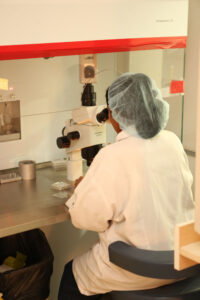
Step 3 – Embryo biopsy Using a precision laser, a small hole is made in the outer shell of the embryo. One or a few cells are gently removed for analysis. This is performed by our specialist embryologists and does not harm the remaining embryo.
Step 4 – Genetic analysis The biopsied cells are sent to a genetic laboratory for analysis. Depending on the test, results are typically available within 24 to 72 hours.
Step 5 – Embryo selection and transfer Embryos identified as chromosomally normal – or unaffected by the specific genetic condition being tested for – are selected for transfer. Unaffected embryos may also be frozen for future use.
PGD FAQs
More embryos give you more options after screening, since not all will be normal. The number that will be available depends on your response to stimulation, your age, and sperm quality. Our team will give you a realistic picture of what to expect from your specific situation before you commit to adding PGD.
Yes. At Conceive Hospital, it is possible to biopsy embryos that will then be vitrified (frozen) and tested. The frozen embryo replacement cycle takes place after results are received. This is often the preferred approach.
PGD can test for a wide range of single-gene disorders including thalassaemia, sickle cell disease, cystic fibrosis, spinal muscular atrophy, Huntington’s disease, BRCA1/2 mutations, Fragile X, and many others. The specific conditions we can test for should be discussed in a consultation – some require prior genetic counselling and laboratory validation before the cycle begins.
Conceive Gynecology and Fertility Hospital offers PGD and PGS at its clinics in Sharjah (near Arab Mall, Al Taawun) and Dubai (Jumeirah Lake Towers). Patients from Abu Dhabi and other emirates are welcome and regularly treated at both locations.
Reach us
Sharjah – Near Arab Mall (Old Al Taawun Mall), Al Taawun, Sharjah Tel: +971-6-5771822 | Mobile: +971-50-8475666
Dubai (JLT) – Near Damas Jewellery Showroom, Jumeirah Lake Towers, Dubai Tel: +971-4-5545 820 | Mobile: +971-50-5817003

