Sperm Tracer – AI sperm Selection
Artificial Intelligence in Fertility Laboratories
Artificial intelligence is transforming fertility laboratories by enhancing precision, consistency, and clinical decision-making across assisted reproductive technologies. AI systems analyze microscopic images and videos, automate complex visual assessments, and support embryologists in tasks that have traditionally relied on subjective human judgment. Using deep learning and computer vision, AI processes large volumes of data in real time, improving accuracy while reducing inter-operator variability. These technologies integrate seamlessly into existing laboratory workflows, serving as decision-support tools rather than replacements for clinical expertise. As a result, fertility clinics are moving toward more standardized, reproducible, and data-driven outcomes.
Sperm Tracer
- AI-Powered Sperm Selection for Assisted Reproduction
- Revolutionizing Fertility Clinics with Artificial Intelligence
Sperm Tracer is one of the world’s first AI based tools designed to assist embryologists in sperm detection and selection during ICSI (Intracytoplasmic Sperm Injection). By combining advanced deep learning algorithms with embryologists’ expertise, Sperm Tracer introduces objectivity, reproducibility, and real-time decision support to a process that has historically been manual, subjective, and difficult to standardize.
Why It Matters
Traditional sperm selection relies entirely on visual assessment by the embryologist, making it subjective, non- repeatable, and highly variable between operators and laboratories. Each sperm contributes 50% of the embryo’s genetic material, making the selection of high-quality spermatozoa critical for fertilization success and embryo development.
Sperm Tracer applies AI driven sperm analysis to improve accuracy, consistency, and training, addressing one of the most challenging steps in assisted reproduction.
Unique Worldwide Features
1. AI-Assisted Real-Time Sperm Selection
Seamless integration of embryologists’ expertise with live AI analysis during ICSI.
2. Deep Neural Network (DNN) Algorithms
Continuously trained on thousands of sperm images, improving performance and accuracy over time.
3. Quantitative and Objective Assessment
Analyzes motility, morphology, and complex kinematic patterns that are undetectable to the human
eye.
4. Advanced Spermatozoa Detection
Identifies sperm in severe oligozoospermia, azoospermia, and surgical samples (micro-TESE, TESA, PESA, MESA), where conventional semen analysis often fails.
5. Four Flexible Analysis Modes
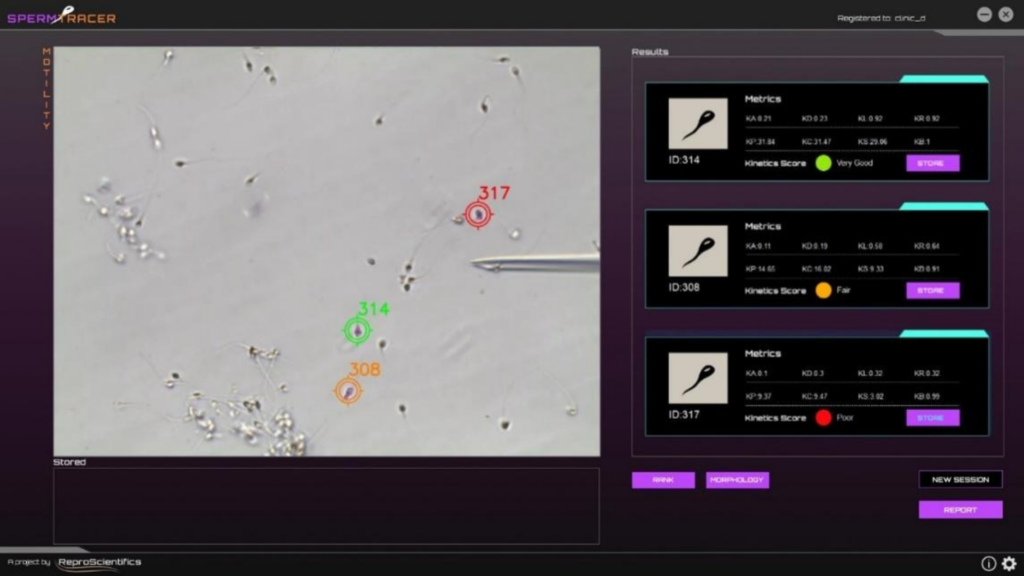
- Motility-based selection
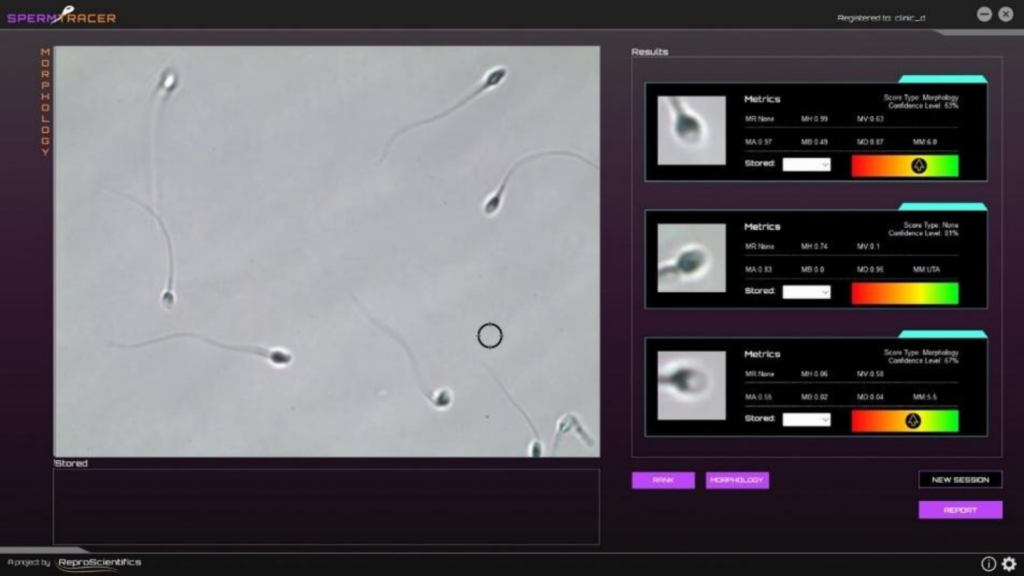
- Morphology-based selection
- Combined motility and morphology scoring
- Detection in severe male infertility cases
6. Ultra-Fast and Objective Selection
Sperm Tracer analyzes and ranks spermatozoa within milliseconds, evaluating motility and morphology in real time. This speed enables embryologists to make informed decisions instantly during ICSI, directly impacting fertilization success and embryo development. Unlike manual assessment, which is time consuming and subjective, Sperm Tracer delivers consistent, data-driven results with every use.
7. Advanced Detection in Severe Male Infertility
In cases of severe oligozoospermia or azoospermia, conventional semen analysis often fails to detect viable spermatozoa. Sperm Tracer’s AI- powered detection algorithms recognize even rare and subtle sperm movements and morphological features. This capability expands treatment possibilities for patients who previously had limited or no options for biological paternity.
Application in Surgical and Specialized Samples
In addition to standard ICSI procedures, Sperm Tracer supports all invasive sperm retrieval techniques, including:
- micro-TESE (Microsurgical Testicular Sperm Extraction)
- TESA (Testicular Sperm Aspiration)
- PESA (Percutaneous Epididymal Sperm Aspiration)
- MESA (Microsurgical Epididymal Sperm Aspiration)
By analyzing these challenging samples with high precision, Sperm Tracer enables the detection and selection of rare viable sperm that may otherwise be missed, maximizing every opportunity for successful fertilization.
Conclusion
For the first time, embryologists worldwide can combine human expertise with artificial intelligence to achieve consistent, objective, and reproducible sperm selection—advancing the future of assisted reproduction.
MORPHOLOGY
MOTILITY